*The History of Recording
By invention of recording technology, many and unspecified public can now listen to
the performance repeatedly which was all a once-in-a-lifetime chance.
People got the technology which exceeds space-time and reproduces a performance
before being born. Recording technology made the pace the same with the player of
classical music all coming to record, and accomplished development.
This report introduces important recording in the history of recording
while it looks back upon development of recording technology.
*The Time of Dawn --- from invention to acoustic recording
Recording technology was invented by Edison in 1877.
Although recorded in the cylinder which used tin, wax, etc. at the beginning,
the Gramophone, which used a disk and was easy to reproduce, was invented in 1887.
A musician came to record around from the next year, and Brahms recorded at 1889 age.
When the 20th century came, early record companies, such as the Gramophone & Typewriter,
Columbia and Victor competed for making a musicians record their performance.
Although the recording of a song occupied many in early stages, by that time,
Joseph Joachim
recorded Hungarian Dance,
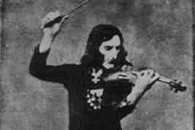
Pablo de Sarasate recorded
Zigeunerweisen
as private recording.
Eugene Ysaye
contracted with the record company, Columbia, for the first time as a violinist in 1910.
Then, Mischa Elman,
Fritz Kreisler,
Jan Kubelik,
Efrem Zimbalist,
etc. followed. Heifetz
called child of a recording age recorded for the first time with Victor in 1917.
In this time, the time which can be recorded was as short as a little less than 5 minutes.
At the time, Heifetz performed the 3rd movement of the
concerto by Mendelssohn
in only 4 minutes and 30 seconds in order to make recording possible.
*Start and Development ---- from opening of an electric recording to LP
Electric recording which records with an electric signal was put in practical use
in 1925 using the microphon. Thereby, many records of the orchestra music for which
reappearance with the record technology till then was the most difficult were provided.
From the time, recording of the concerto by accompaniment of orchestra
also comes to be performed. By realization of electric recording,
dynamic-range and a recording-zone show fast improvement, and recording
of the standard number by noted players, such as complete works of Beethoven's sonata
by Fritz Kreisler, was performed successively.
The following trial was the challenge to prolonged inclusion of a performance.
Victor dropped the number of rotations of a record on 33 1/3 rpms, and recorded
the No. 5 symphony of Beethoven. However, the signal to noise ratio was extremely bad,
and the record of this system did not spread. It was in 1948 that LP (Long Playing)
which was compatible in tone quality and the prolonged performance at the number of
rotations of 33 1/3 rpms was put in practical use by the improvement in the quality
of the material. The first LP was the violin concerto of Mendelssohn by
Nathan Milstein
put on the market from Columbia. After that, LP received various improvement,
such as number of rotations and size, and popularization progressed increasingly.
Simultaneously, large and small record companies flooded. It came to call the record of
the conventional acoustic recording of 78rpms SP (Standard Playing) to LP at the time.
*Pursuit of the further improvement --- from stereo recording to digital age
Each record company put stereo recording LPs on the market with respectively
original systems from about 1956. Stereo is a system expressing three-dimensional sound
by recording the sound source using two or more microphones and reproducing it from
two or more speakers. It does not differ from LP gas till then in respect of tone quality.
However, the presence of a hole and the sincerity of sound improve by leaps and bounds.
There were some players who recorded again the piece recorded in the past by the stereo.
Although Heifetz had already recorded most standard concertos, he recorded
principal repertories by the stereo after that. Although
Michael Rabin
recorded the Paganini's First Violin Concerto in 1955, he recorded the same piece again
only five years after.
In this way, recording technology accomplished development and rushed into the digital age.
By utilization of CD (compact disk), the signal to noise ratio, the dynamic range,
and the recording zone progressed leaps and bounds so that it can't be recognized with
human's ear. Classical music fans who were particular about sound played a role in CD's spread.
Since the outside of the range of certain frequency is cut, some people criticize that
CD sound is too mechanical. However, since handling is not only easy,
but has the character peculiar to digital one in which it does not deteriorate semipermanently,
CD is a precious information medium. In the latest recording, mastering is also
digitized and mastering is carried out at the sampling rate exceeding CD.
In the above, the history of recording from invention to the present age was described.
Probably, you may say that it developed till the place which will not already be more than
this by the end of the 20th century technically. It is likely to become comprehensive
producing of recording, i.e., the time when a soft side is needed, from now on.
For example, mixing of the solo part of a concerto was comparatively large till the 1970s.
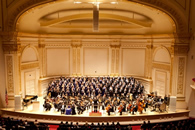
When entering in the 1980s, mixing to reproduce near the performance listened to in a concert hall
by installing a microphone in one place became in use. But in the 1980s,
the microphone was installed in one place and the recording technique which acquires
the effect near the performance listened to in a concert hall became in use.
However, with this method, the solo is scratched out by the orchestra and
such recordings cannot reproduce the presence of real performance.
Progress at such a point is expected from now on.